
Gabriel Magalhães injury watch: What happened, and what comes next
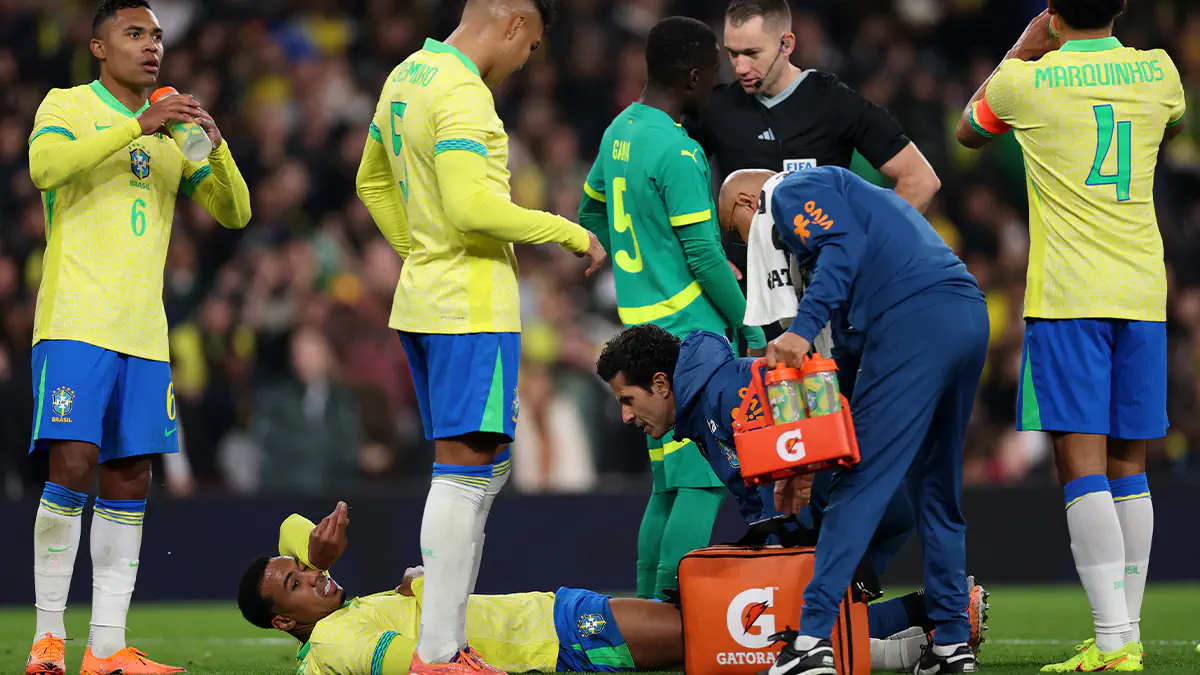
Gabriel pulled up mid-sprint during a defensive transition for Brazil, immediately reaching to his upper inner thigh (groin/adductor). Carlo Ancelotti confirmed it was an adductor injury, with a thorough evaluation scheduled. In the hamstring–groin spectrum, symptoms closer to the hip (proximal) warrant a bit more caution than a routine mid-belly tweak.
The injury mechanism
This occurred during a high-speed recovery run, though it could also have happened as he turned back into the sprint. As he raced back, the adductors were lengthening while contracting (eccentric action) to bring the leg back under the body and stabilize the hip and knee at pace. Add a sudden deceleration or stride adjustment under fatigue, and fibers near the proximal origin can overstretch or micro-tear.
Anatomy involved (key structures)
- Adductor longus (most commonly affected), especially the proximal tendon/musculotendinous junction at the pubic tubercle.
- Possible secondary involvement: adductor brevis and/or gracilis, depending on fiber recruitment.
- Surrounding fascia/aponeurosis may be irritated; MRI will pinpoint the primary site and grade.
This presentation does not suggest athletic pubalgia. It looks like an acute adductor strain from a sprint-back incident, not a chronic core–groin junction overload.
Why proximal pain matters (without the trendy pubalgia talk).
When pain is high up near the adductor origin, recovery is often slower than with a mid-muscle strain because that region absorbs higher loads during long strides, but also has poorer blood supply compared to the muscle belly. It’s still a strain, but proximal involvement can extend the timetable compared to a minor mid-belly tweak.
Grades & realistic timeframes (guide ranges):
- Grade 1 (mild strain): 1–3 weeks (day-to-day).
- Grade 2 (moderate strain): 3–6 weeks.
- Grade 3 (high-grade strain): 6–8+ weeks.
MOST elite groin strains fall into Grade 1–2 with smart, criteria-based progression. Proximal symptoms are why Grade 2+ remains possible until imaging is complete.
What scans will answer:
- Location: muscle belly vs. proximal tendon/musculotendinous junction.
- Extent: length of edema (the more, the longer the recovery), partial vs. high-grade tearing.
- Adjacents: bursal/fascia irritation; any features that would slow tolerance to braking or long-stride work.
MRI will confirm the grade and site, which directly determines how quickly he can handle decelerations, opening up, and long recoveries. Whether we get all this info is another story!
Return-to-play roadmap (typical criteria):
- 1. Settle symptoms → pain-modulated loading; adductor isometrics to maintain muscle tone.
- 2. Strength rebuild → focus on adductor longus + lower abs/obliques/hip complex; progress to controlled eccentrics (e.g., Copenhagen progressions).
- 3. On-pitch progressions → linear runs → decelerations → change-of-direction → ball-striking tolerance.
- 4. Good signs → pain-free adductor squeeze; near-symmetry on handheld/isometric strength; no next-day flare after full-speed turns/strikes/recoveries. Force plate testing confirms no discrepancies.
- 5. Match return → as a centre-back and a key player, he’ll start when ready (unlikely to be eased in with short cameos).
Squad/tactical quick take:
- If short-term absence: Expect Piero Hincapié as the most likely replacement.
- On return: early matches may emphasize structure to reduce repeated long recoveries (line height, cover angles) while he readapts to braking and turning workloads.
Bottom line:
- Working diagnosis: Acute adductor strain, sustained during a sprint-back.
- Most likely window: Grade 1–2 → 1–6 weeks, pending MRI.
- Key watch-item: Proximal tendon involvement on imaging = slower ramp; if it’s purely low-grade muscle, a quick return is possible. However, this is unlikely, as we would have already heard from Arsenal about a potential grade 3 and any surgical or non-operative management. Still awaiting confirmation.
We’ll provide updates once imaging and his first steps back on grass clarify whether this is a short, straightforward Grade 1 or a deeper Grade 2 that needs a few weeks of careful management.
There are rumors he’ll miss the North London Derby, and Brazil’s statement says he “underwent tests that revealed a muscle injury in his right thigh.” That wording is broad and doesn’t change much—our working hypothesis remains an adductor (groin) strain, consistent with him grabbing the groin area on video; final grade and timeline await Arsenal’s imaging and Arteta’s comments.
Follow PhysioScout on X and Instagram if you love this kind of analysis!
 Physio Scout
Dailysports's expert
Physio Scout
Dailysports's expert