


Weekend Injury Report: Who’s Hurt, How Bad, and What It Means
A heavy weekend of football delivered a few alarm bells — especially for Arsenal — plus some potentially serious concerns elsewhere. Here’s what happened, what it likely is medically, and how long these players are usually out.
Gabriel Martinelli – Monitoring a possible groin/adductor issue
Arsenal winger finishes sore, but no major red flag yet
What happened
Gabriel Martinelli finished the match but reported “feeling something” afterwards. Arsenal haven’t officially labelled it, but that language, he completes the game, then reports discomfort, is very typical of early groin/adductor or hamstring irritation in wide players.
These areas take a huge load in his role: repeated sprints, cuts inside, and striking off balance. Crucially, there wasn’t a single dramatic moment on broadcast where he pulled up or grabbed at the back of the leg. That lowers concern for a high-grade tear.
What this usually is
This pattern generally falls into one of two buckets:
- Overload/tightness: irritated muscle but intact.
- Low-grade (Grade 1) strain: a mild fibre strain where the player can still function
With more serious strains (Grade 2+), you normally see an obvious stop, reduced top speed, and the player signalling to come off immediately.
Typical timelines
- Tightness/overload: can settle in under a week with rest and controlled running.
- Grade 1 groin/adductor strain: ~1–2 weeks.
- Grade 2: ~3–4+ weeks.
The outlook
Right now this looks short-term and manageable.
Declan Rice – Contact to the calf, not a strain
Calf contusion more than calf ‘injury’
What happened
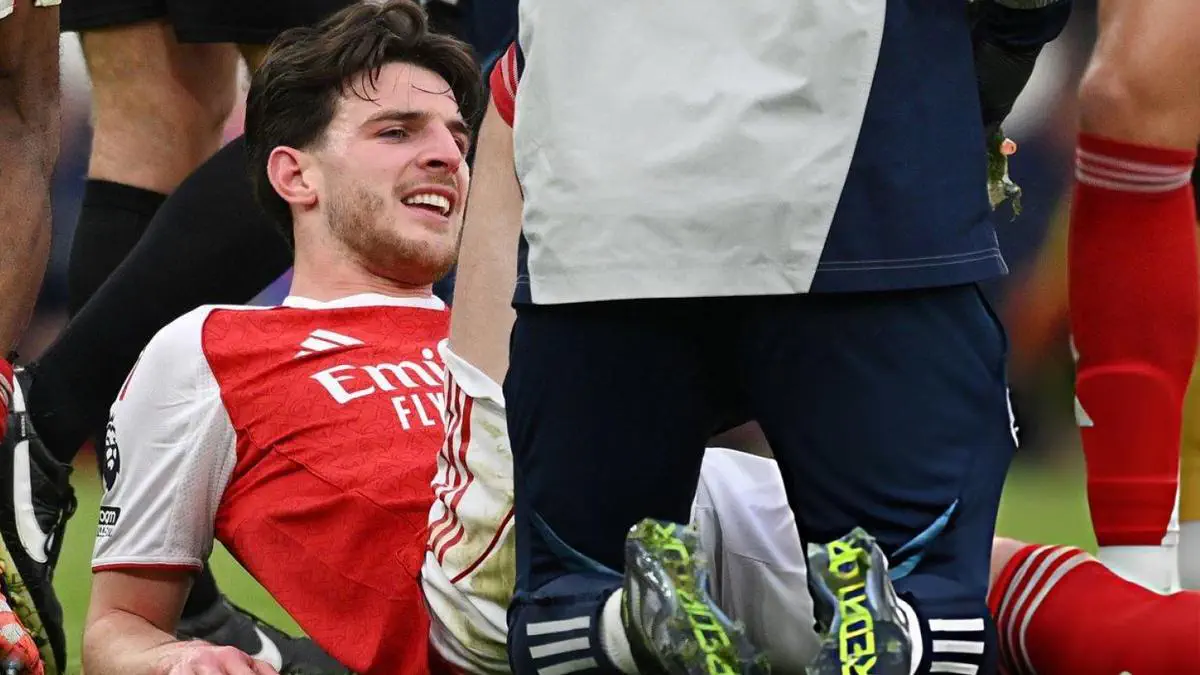
Declan Rice took a knock to the calf in the first half, played on, and was subbed off later. Based on how it presented, this is most consistent with a calf contusion (a deep bruise from contact) rather than a muscle tear.
Why that matters
A contusion is basically blunt force trauma to the muscle. You can often keep going in the moment, but it stiffens and swells over time. A strain behaves differently; players usually can’t continue at full intensity, especially in accelerations and longer passing actions.
Typical timeline
Most straightforward calf contusions calm down in about a week, sometimes even half a week. The main job is just settling the swelling and making sure he doesn’t start compensating and overload something else.
The outlook
This is expected to be short-term. Barring something unexpected on assessment, this is “miss a few days, then back, ”not “out for weeks”
William Saliba – Precaution at half-time
No obvious mechanism = usually minor soft-tissue warning/bruise
What happened
William Saliba was removed at half-time. Mikel Arteta said the issue was enough that he “had to be out” for the second half, but there was no clear incident on the broadcast: no sprint grab, no heavy clash, no moment where he visibly broke down.
Possibly a hard landing from Gabriel caused this.
What that usually means
When a defender is taken off at the break without a clear mechanism, it’s often early groin/hip/adductor tightness or general overload/
Typical timeline
These cases commonly fall into the within a week range. Sometimes the player is
available the next matchday (often initially on the bench), depending on how he
responds in the first couple of training sessions.
The outlook
Saliba’s removal reads as controlled risk management rather than a major structural problem. Nothing here suggests a long-term absence unless scans say otherwise.
Riccardo Calafiori – Late-game tightness
Looks like fatigue management, not structural damage
What happened
Riccardo Calafiori came off late with discomfort but walked off normally. There was no dramatic mechanism, which points toward simple muscular overload/fatigue rather than an acute tear.
This is common in congested periods, especially for defenders who have to repeatedly swivel, recover, and open the hips under pressure. Those repeated changes of direction load the groin and hip stabilisers hard.
Typical timeline
Should manage within the week range.
Curtis Jones – Groin/adductor concern
Self-reported soreness, walked off under his own power
What happened
Curtis Jones was substituted in the 70th minute of Liverpool’s 3–2 loss to Brentford with what appeared to be a groin problem. Arne Slot confirmed Jones asked to come off, but importantly, he walked off.
That profile, groin discomfort, player calls it early, no collapse, is classic adductor overload with a low chance of a strain
Typical timelines
- Grade 1 adductor/groin strain: ~0.5–2 weeks and often managed day-to-day.
- Grade 2: ~3–4 weeks.
Low-grade adductor strains tend to respond quickly to rest and progressive reload (isometrics, then controlled change of direction, then ball striking). In those cases, it’s more “protect him for a game or two”.
The outlook
Encouraging. Early removal and the fact he walked off both lean toward a mild presentation. He’s in short-term doubt, but this doesn’t automatically read as a multi-week absence.
Emiliano Buendia – Foot/midfoot worry
Boot and crutches after Man City match raises Lisfranc / fracture concern
What happened
Emiliano Buendia had to come off for Aston Villa against Man City after what looked like a fairly harmless tussle with Matheus Nunes. Post-match, he was seen on crutches and in a protective boot.
When you see midfoot pain plus immediate immobilisation like that, the concern jumps to two things:
- A midfoot (Lisfranc) ligament injury, or
- A fracture through that region.
Even “innocent-looking” foot mechanisms can produce serious midfoot damage if the foot is planted and force goes through the arch.
Why this matters
The Lisfranc complex is what stabilises the arch of the foot. If that structure is compromised, it can sideline players for a long stretch. You can’t just tape it up and play through, planting, pushing off, striking the ball, everything hurts.
Typical timelines
- Stable fracture/mild midfoot injury: ~6–12 weeks.
- Significant Lisfranc damage: 3–5 months is common, sometimes requiring surgery.
- There are lighter Lisfranc-type sprains that get back in 2–4 weeks, but that’s the optimistic ceiling and depends entirely on clean imaging.
The outlook
This is one Aston Villa will be nervous about. Until scans rule out Lisfranc involvement or a fracture, you have to treat this as potentially long-term, not day-to-day.
Oliver Scarles – Shoulder dislocation
What happened
Oliver Scarles was forced off in the 25th minute of West Ham’s 2–1 loss to Leeds United with what the club described as a dislocated shoulder. He’d just put together back-to-back starts on the right flank and was settling into first-team minutes.
Shoulder dislocations usually come from either landing awkwardly on an outstretched arm or having the arm forced backwards. The ball of the upper arm (humeral head) slips out of the socket.
Why it’s tricky
Once a shoulder has dislocated, the long-term question is stability. Does it stay in place under load, or is it now prone to slipping again?
Typical timelines
- If the joint is reduced and stable, and there’s minimal soft tissue damage: ~2–4 weeks out is common.
- If it’s unstable and needs surgical stabilisation: closer to 3 months.
The outlook
Either way, this interrupts Scarles’ momentum just as he was breaking through. Even in the best-case 2–4 week scenario, West Ham will be cautious, because recurrent shoulder instability can become a recurring problem for young players.
Kevin De Bruyne – High-grade hamstring tear
This one is big: months, not weeks
What happened
Kevin De Bruyne suffered a hamstring injury for Napoli against Inter, appearing to hurt himself after taking a penalty. Early indications are that this is a Grade 3 hamstring tear.
A Grade 3 is essentially a full-thickness rupture of part of the muscle-tendon unit.
You’re looking at significant pain, weakness, and immediate loss of explosiveness.
Why this is serious for him
De Bruyne has a history of serious hamstring trouble. His last major hamstring injury (to the right side) required surgery and cost him roughly five months. When a player with that history suffers what sounds like another high-grade tear, timelines tend to stretch rather than compress.
Typical timelines
- High-grade hamstring tears managed conservatively: ~8–10 weeks is the optimistic scenario.
- Surgical repair / tendon involvement: 3–5 months is standard. Realistically, for a player who relies so much on acceleration, striking through the ball, and repeat high-intensity actions, 4–6 months out is absolutely in play.
The outlook
This is the most serious situation of the weekend. Unlike the Arsenal cluster (mostly load management) or the short-term soft-tissue flags, De Bruyne’s injury has true long-term implications for Napoli’s season.
Bottom line: The Summary
- Arsenal’s injuries (Martinelli, Rice, Saliba, Calafiori): mostly read as load, tightness, knocks. Annoying, but not “months out.”
- Liverpool (Curtis Jones): mild groin/adductor profile, most likely days to a couple weeks unless scans say Grade 2.
- Aston Villa (Buendia) and West Ham (Scarles): real concern. Buendia’s foot/midfoot and Scarles’ shoulder dislocation both carry multi-week to multi-month downside.
- Napoli (Kevin De Bruyne): headline long-term absence. A likely Grade 3 hamstring tear at his age and history can easily turn into a 4–6 month layoff.
Thanks for reading through our summary of the relevant injuries in the last weekend’s fixtures!
For more real-time injury reports, follow @PhysioScout on all platforms!
 Physio Scout
Dailysports's expert
Physio Scout
Dailysports's expert



