

Mourinho’s €25m debut hero: Who is Carlos Espí?



Just a few months ago, the 21-year-old forward was fighting for a starting spot at Levante and battling to keep the team in La Liga. Now, he's scoring the match-winning goal for Real Madrid in José Mourinho’s first game back in Spain’s top flight. Here’s the story of Carlos Espí—a nearly two-meter tall student once rejected by Valencia, but bought by Madrid for €25 million.
Sometimes, a single decision by a coach can change a career. Sometimes, it only takes one goal. For Carlos Espí, the past eight months have been packed with pivotal moments.
- Also read: Catalans kick off title defense against a familiar foe: prediction for Elche vs Barcelona.
On August 22, Real Madrid took on Espanyol in their first match of the new La Liga season—and Mourinho’s first official league game since returning to Madrid. Jude Bellingham opened the scoring in the ninth minute, Alex Calatrava quickly equalized, and then Madrid’s star-studded attack struggled to break down the hosts.
In the 80th minute, Mourinho sent on Espí. Ten minutes later, the new signing was exactly where a true center forward should be. Kylian Mbappé broke into the box, lost the ball in a challenge, chaos ensued—and Espí reacted quicker than the defenders. He sidestepped Marko Dmitrovic and slotted the ball home.
2-1. Real Madrid win. Espí’s first official goal for the club. A dream debut for a player who wasn’t even in Madrid a month ago.
For Mourinho, it was his first La Liga match since returning to Real after more than 13 years; for Espí, his first league appearance in a Los Blancos shirt. After the game, the Portuguese manager emphasized exactly why the club needed this kind of striker: when the opportunity arose to sell Gonzalo García to Fulham, chief scout Juni Calafat suggested several options, but the coach was looking for a very specific profile—a forward who could play with his back to goal, tie up center-backs, and live inside the penalty area.
"We need a player like this in matches of this type," Mourinho explained.
It all started with a sacking at Nantes
The most fascinating part of Espí’s story is just how much his fate depended on events he had no control over.
On December 10, 2025, Nantes sacked Luís Castro. Club owner Waldemar Kita would later call hiring the Portuguese coach one of his biggest mistakes, sarcastically suggesting Castro could "relegate two clubs in one season."
Ten days later, Castro had a new job.
On December 20, bottom-of-the-table Levante announced Castro as their new head coach. The team had just 11 points from 17 matches and looked doomed for relegation. The club highlighted one key trait of their new boss: his ability to develop young players.
For Espí, that changed everything.
Before Castro’s arrival, the young striker was on the fringes of the first team. That summer, Levante had even considered loaning him out, as then-coach Julián Calero didn’t see enough minutes for him. Espí and his camp decided to stay and fight.
It was a risky call. He could have lost an entire season.
Instead, within months, Carlos became La Liga’s best young player.
From first start to 11 goals in a matter of months
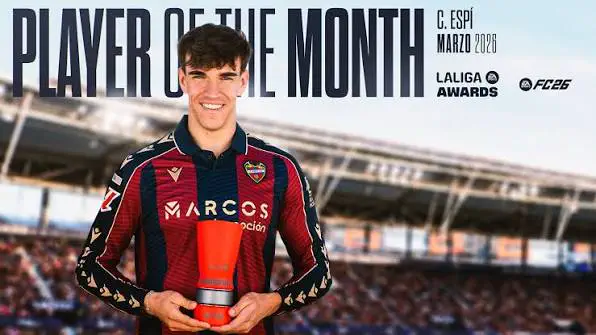
Espí made his first-team debut for Levante on February 18, 2024—in the Segunda against Racing Ferrol. He was 18. He scored his first senior goals soon after, and in the 2024/25 season netted six times in 36 league games as Levante earned promotion to La Liga.
But his real breakthrough in the top division came two years later.
Espí’s first La Liga start was February 18, 2026, against Villarreal. Just nine days later, coming off the bench, he bagged a brace against Alavés.
After March 7, Castro never dropped him from the starting XI again.
By season’s end, Espí had only 13 starts but scored 11 goals in 25 league appearances—10 of those coming in the final 13 rounds.
In March, Carlos scored against Alavés, Girona, Rayo Vallecano, Oviedo, and transformed from an unknown benchwarmer into one of Spain’s most talked-about forwards.
La Liga named Espí Player of the Month for March, ahead of Federico Valverde, Lamine Yamal, Gonçalo Guedes, and Santi Comesaña.
But his biggest challenge still lay ahead.
The forward who saved Levante
When Castro arrived, Levante were dead last. But going into the final rounds, they were in control of their own destiny.
Espí scored when it mattered most.
On May 17, at home to Mallorca, he opened the scoring. Levante won 2-0 and were all but safe. A week later, Carlos scored again—this time against Betis. The team lost 1-2, but the job was done: Levante survived.
Castro had taken over with just 11 points from 17 games and kept them in La Liga.
The very coach whom Kita claimed would "relegate two clubs" had saved the Spaniards. And the forward whom few had trusted finished as Levante’s top scorer.
In June, La Liga named Espí U23 Player of the 2025/26 season. He beat out Fermín López, Arda Güler, Alberto Moleiro, and Víctor Muñoz in the final vote.
Almost two meters, but not just a ‘target man’
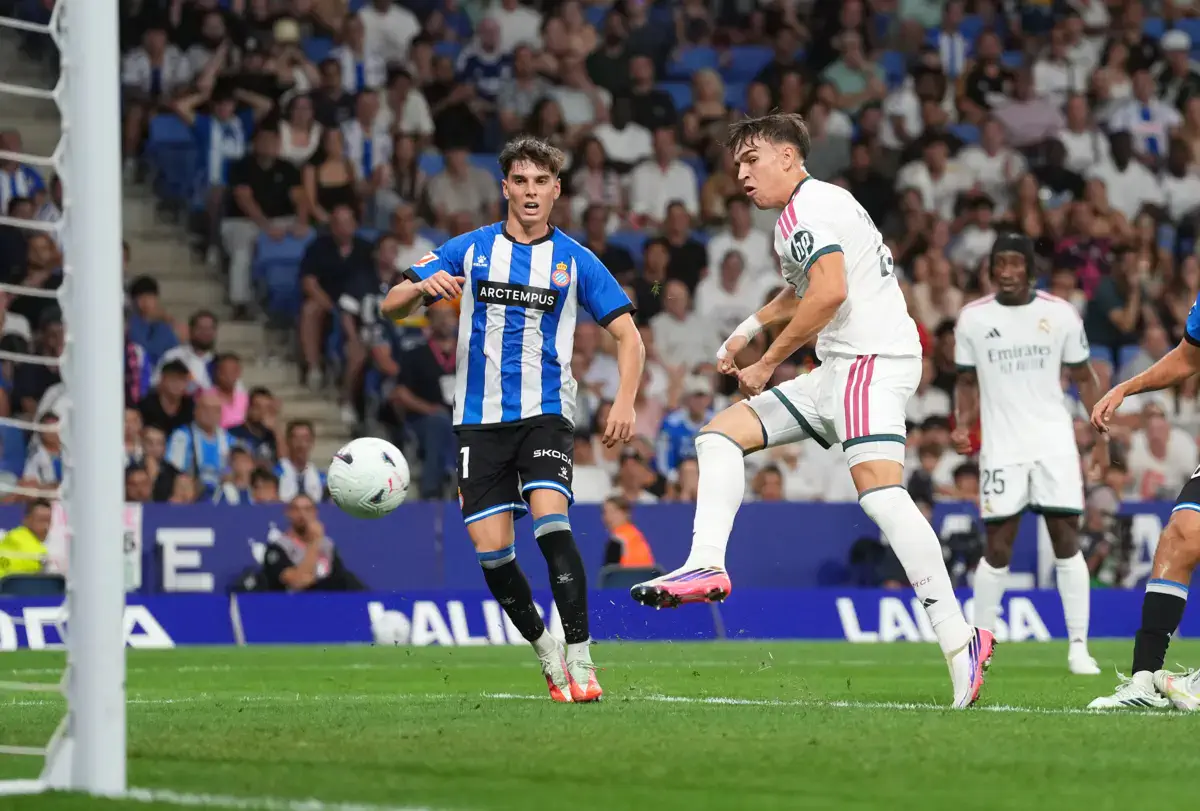
It only takes one look at Espí to understand why Mourinho was interested.
Height: about 1.94 meters. Powerful build. Physical presence. Plays with his back to goal. Wins aerial duels. Always lurking in the box.
But he’s not just an old-school battering ram No. 9. Espí is far more mobile than his frame suggests. He can press aggressively, run in behind defenders, and attack open spaces. In Spain, pundits noted that despite his height, he can reach speeds of around 32 km/h.
He’s adept at latching onto long balls and dragging center-backs out of position—precisely what Mourinho wants from a backup target man.
Real Madrid have already had success with this kind of role—think Joselu. You don’t have to play 90 minutes every week to decide matches that could define a season’s trophy haul.
Against Espanyol, Espí needed just 10 minutes.
His agent is also his mentor

Pep Serer plays a huge part in this story.
The former Valencia, Villarreal, and Mallorca player first spotted Espí as a teenager at Alzira. A friend told him about a tall youngster with a rare mix of physique and finishing instinct. Serer only needed to watch him once to be convinced.
He later helped arrange Espí’s move to Levante’s academy and became not just his agent but a true sporting mentor over the years.
One telling detail: Espí could have ended up at another big club in the Valencia region. Valencia CF scouted him. The club even had an agreement with Alzira, but at Mestalla they decided to pass on the forward.
Instead, offers came from Alavés and Levante. Carlos chose the latter: closer to family, easier to keep studying, less pressure to rush his career.
In summer 2022, he joined Levante’s academy. With Juvenil A, he became a champion, and by 18 he was in the first team.
Long before the Madrid move, Serer said Espí had the tools for the very highest level. Later, his prediction grew bolder: in his agent’s view, Carlos “can play for any club in the world.”
A few months later, Real Madrid came calling.
University life—not just football

Another detail says even more about Espí than his stats.
Despite professional football, tough training, and extra physical work, he kept studying.
Carlos is studying sports science. Serer recalls that after morning training, Espí would sometimes get home by 3pm, have lunch, and immediately head off to classes.
For his agent, education was a must. Football careers are short, and discipline and learning should remain regardless of how many goals you score.
"Without hard work and humility, it’s very hard to achieve anything," Serer said.
People close to Espí say he kept working on his fitness and recovery even when he wasn’t making the squad. That’s why, when Castro finally gave him a run of games, he was physically ready.
Grandmothers who worry when he gets kicked

One of the season’s warmest stories came after that crucial match against Mallorca.
Carlos had specially invited his grandmothers—Maria and Conchin—to the stands. They rarely watched his games live, and first needed some convincing.
The striker somehow knew it would be a special night.
And so it was: Espí scored, Levante won one of their most important games of the season, and after the final whistle, Carlos went straight to his family.
Later, he recalled with a smile:
"My grandmothers always tell me opponents kick me too much, and they don’t like it."
It also turned out that one of them analyzes matches like a strict coach: instead of compliments, she’ll ask why her grandson didn’t finish a certain chance:
"One of them—yes, for her, everything is always great. But when I go to the other’s house, it feels like I did nothing right. She’ll ask: why didn’t I score that chance, or the other one… But today they were both very happy."
Levante fans chanted Espí’s name, while his grandmothers in the stands watched their grandson become a city hero.
Real sold one academy product for more and bought another striker for less
Everything happened fast in the summer.
Brighton were seriously pursuing Espí, and there was interest from other foreign clubs. But once Real Madrid entered the race, all other talks stopped.
Mourinho wanted a different type of striker after Gonzalo García left in search of more game time. Chief scout Juni Calafat suggested Espí, Mourinho personally approved, and got in touch with the player.
On July 30, Real Madrid officially announced the signing. The contract runs until June 30, 2031. The club and Levante didn’t disclose the fee, but Spanish media were unanimous: €25 million. For Levante, it was the biggest academy sale in club history.
Almost simultaneously, Gonzalo García joined Álvaro Arbeloa at Fulham. The English club paid around €40 million, with Real keeping a stake in their academy graduate’s rights.
It was a shrewd deal: sell an academy striker for more than his replacement cost, keep a future interest in his value, and land exactly the profile the coach wanted.
García left a Real dressing room that had endured two trophyless seasons, internal conflicts, and a spring scandal between Aurélien Tchouaméni and Federico Valverde. Espí arrived with a clean slate—after a completely different experience: a relegation fight, university classes, extra training, and evenings when his grandmothers worried about rough defenders.
€25m already paying dividends
At first, Espí looked like just another backup striker.
For €25 million, Real weren’t buying a superstar or even a Spain international. They were buying a specialist for Mourinho: tall, hungry, aggressive, a number nine willing to wait for his chance.
But that’s what Carlos has done his whole career—waited.
Waited for Levante to trust him with the first team. Waited for his status to change after promotion. Stayed when advised to go on loan. Waited for Castro. Got his first start. Scored through the spring. Saved the team. Became La Liga’s best young player.
And now, he’s seized his moment at Real Madrid.
Ten minutes against Espanyol—and €25 million already looks less like a fee for an unknown striker from a struggling club, and more like an investment in a profile built to win matches like this.
Yes, Espí probably won’t ever displace Mbappé or become the face of Real Madrid. But that’s not what’s required. Forwards like him just need to be in the right place at the right time in the 90th minute.
 Steven Perez
Dailysports's expert
Steven Perez
Dailysports's expert