
Raphinha out, Mané back: The biggest shocks of the 2026 Ballon d'Or shortlist
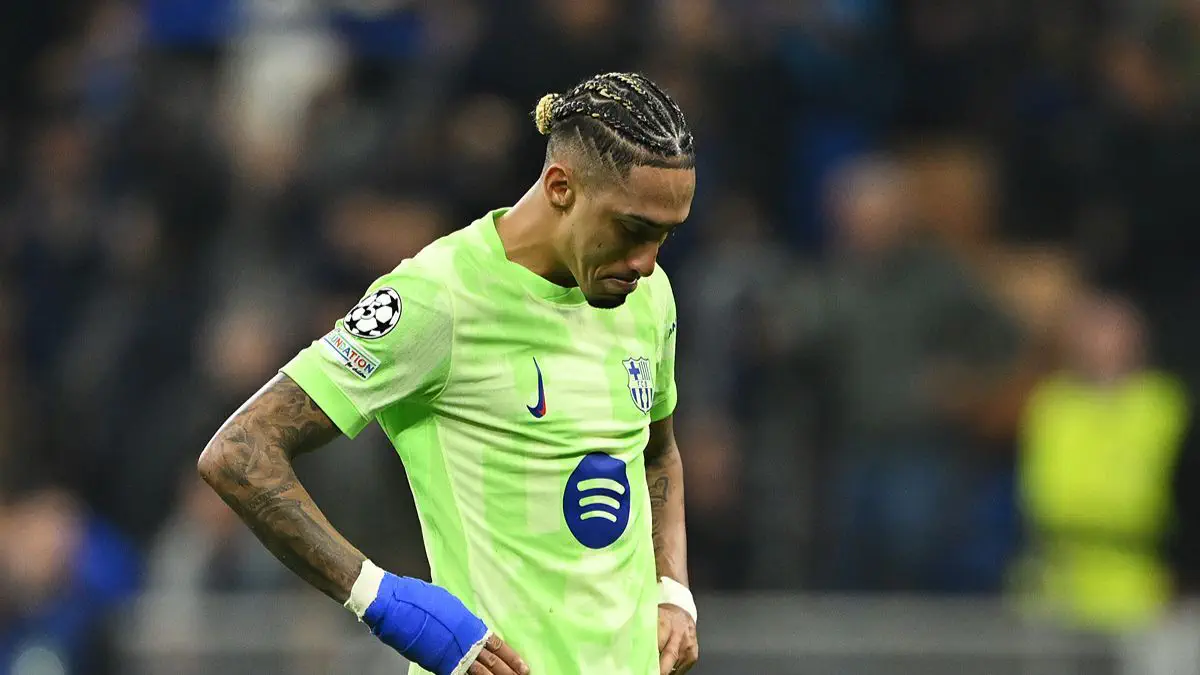
Désiré Doué and World Cup winner Mikel Oyarzabal have incredibly missed the cut, while Saudi Pro League stars Julián Quiñones and Sadio Mané are among the 30 nominees. Dailysports takes a look at the biggest surprises from the newly announced 2026 Ballon d'Or shortlist.
The full list of 30 nominees for the 2026 Ballon d'Or has finally been revealed — and, as always, France Football's selection has provided almost as much material for debate as the eventual ranking itself.
The 70th edition of the award will be presented at the London Palladium on October 26, with the ceremony moving away from Paris for the first time. The men's shortlist includes the expected superstars: Harry Kane, Kylian Mbappé, Lamine Yamal, Rodri, Erling Haaland, Ousmane Dembélé, Vinícius Júnior and Lionel Messi are all there.
But the real discussion began lower down the list.
Paris Saint-Germain have an extraordinary ten current players among the nominees, including summer signing Ferran Torres — a Ballon d'Or record — yet one of the most talented members of the team that retained the Champions League is absent. Spain have six representatives after winning the World Cup, but somehow their five-goal World Cup striker Mikel Oyarzabal is not one of them. And Barcelona's Raphinha has gone from fifth in the world to outside the top 30 in just 12 months.
At the other end of the scale, the shortlist contains two Saudi Pro League forwards few would have confidently predicted a year ago: 34-year-old Sadio Mané and Al-Qadsiah's remarkable Mexican striker Julián Quiñones.
So who were the biggest winners and losers when the list was announced?
Surprise omissions
1. Désiré Doué — the biggest snub of them all?

Raphinha's absence will generate headlines around the world, but the most difficult omission to explain may actually be Désiré Doué.
Le Parisien immediately described the Frenchman's absence as the main surprise of the 30-man list. The contrast is particularly striking because PSG have flooded the shortlist with nominees, yet Doué is the only regular starter from their Champions League-winning side who has been left out.
And it is not as though he endured a poor season.
Despite injury problems, Doué finished 2025/26 with 13 goals and 11 assists in 41 matches for PSG. Five of those goals came in the Champions League, which Luis Enrique's team won for the second consecutive season. The 21-year-old also collected the Ligue 1 Young Player of the Year award for a second straight campaign.
His World Cup was hardly disastrous either. Doué featured for France and scored in their 4-1 group-stage victory over Norway before Les Bleus eventually reached the semi-finals.
Then comes perhaps the most remarkable detail: Doué finished 14th in the 2025 Ballon d'Or.
A player who was already considered the 14th-best footballer in the world, remained an important member of a team that defended the Champions League and continued producing at both club and international level has now disappeared completely from the top 30.
Among all the omissions, this one is the hardest to understand.
2. Mikel Oyarzabal — the numbers make almost no sense

If Doué is the most surprising omission in terms of reputation and club success, Mikel Oyarzabal may have the strongest statistical case of anyone who missed out.
GOAL's final post-World Cup Ballon d'Or power ranking placed the Real Sociedad captain 15th. His 2025/26 numbers across club and country were exceptional: 32 goals and nine assists, while he finished the campaign as both a World Cup winner and Copa del Rey winner.
The World Cup should have strengthened his case dramatically.
Oyarzabal scored five goals during Spain's victorious tournament, becoming La Roja's leading scorer in North America. He started the final against Argentina and played at centre-forward as Spain secured their second world title.
This was, by almost any measure, the best season of his career.
And yet he is not among the 30 nominees.
The decision becomes even more fascinating when compared with Ferran Torres. Torres unquestionably produced the single most important Spanish goal of the year, but Oyarzabal had far greater overall production and was Spain's starting striker throughout the World Cup.
One is a Ballon d'Or nominee. The other is not.
Few selections on this year's list will create a bigger debate.
3. Raphinha — from fifth in the world to outside the top 30

Twelve months can be a very long time in Ballon d'Or football.
Raphinha finished fifth in the 2025 Ballon d'Or, behind only four players on the planet. In 2026, he did not even make the shortlist.
His season was certainly less spectacular than his extraordinary 2024/25 campaign, but calling it poor would be ridiculous.
Despite missing a significant part of the season through injuries, the Brazilian scored 21 goals for Barcelona, matching Ferran Torres and finishing behind only Lamine Yamal in the club's scoring charts. He helped Barça win La Liga and the Spanish Super Cup, and was named MVP of the Super Cup final after scoring twice against Real Madrid.
The World Cup probably changed his Ballon d'Or trajectory.
Raphinha started Brazil's opening two matches but muscular problems prevented him from playing again. Brazil subsequently crashed out against Erling Haaland's Norway in the round of 16.
In a year in which international football inevitably carried enormous weight, that absence at precisely the wrong moment appears to have been costly.
Still, the headline remains brutal:
From fifth in the world to outside the top 30.
4. Pedri — a world champion left behind

Pedri's omission is less outrageous statistically than those of Doué, Oyarzabal or Raphinha, but it may be one of the most interesting footballing debates.
The Barcelona midfielder played 43 official matches in 2025/26, providing 12 assists — the best total of his career — and scoring twice. He remained the central figure in Barça's midfield as Hansi Flick's team won La Liga and the Spanish Super Cup.
Then he went to the World Cup and became a world champion. Barcelona's own profile notes that Pedri appeared in every match during Spain's victorious tournament.
Yet when the Ballon d'Or shortlist arrived, Spain had six nominees — Lamine Yamal, Pau Cubarsí, Marc Cucurella, Rodri, Fabián Ruiz and Ferran Torres — and Pedri was not among them.
That is what makes the decision notable.
Pedri's game has never been defined by goals, and that can become a disadvantage in individual awards. But if one of the most important midfielders for the Spanish champions can play a role in a World Cup-winning national team and still miss the top 30, the question of how creative midfielders are evaluated in Ballon d'Or voting returns once again.
5. Bradley Barcola — another PSG casualty

Doué was not the only member of PSG's attack to miss out.
Bradley Barcola, who left Paris for Liverpool this summer, played 49 matches for PSG in 2025/26, scoring 13 goals and providing seven assists. He was part of the side that retained the Champions League before travelling to the World Cup with France.
And on the international stage he finally found his scoring touch, netting three World Cup goals as France reached the semi-finals.
French coverage immediately grouped Barcola with Doué among the notable omissions.
His case is not quite as strong as his former PSG team-mate's. Barcola was not always an automatic starter under Luis Enrique, and the competition in Paris' attack was enormous.
But when so many members of the same Champions League-winning squad are included, leaving out a 24-year-old forward who also scored three times at the World Cup inevitably stands out.
6. Julián Álvarez — brilliant in Europe, but still outside

Julián Álvarez probably belongs in the category of "debatable omission" rather than outright robbery.
Still, his numbers are more than strong enough to ask questions.
The Atlético Madrid striker finished 2025/26 with 20 goals and nine assists in 49 appearances. More impressively, ten of those goals came in the Champions League — a new single-season European Cup record for an Atlético player — as Diego Simeone's side reached the semi-finals.
Álvarez also reached another World Cup final with Argentina. He started alongside Lionel Messi against Spain and played 101 minutes before being substituted in extra time.
It is perhaps understandable given the enormous competition among forwards this year.
But ten Champions League goals, 29 club goal contributions and a World Cup final appearance would normally look very much like a Ballon d'Or résumé.
Surprise inclusions
1. Julián Quiñones — how did a Saudi Pro League striker reach the Ballon d'Or top 30?

If there is one name on the shortlist that will make casual European fans immediately reach for Google, it is Julián Quiñones.
The Mexican international has been selected ahead of Oyarzabal, Raphinha, Doué and Álvarez despite playing his club football for Al-Qadsiah in Saudi Arabia.
At first glance, it looks like the wildest selection of the entire list.
Then you see the numbers.
Quiñones scored 37 goals in 35 club appearances, according to reports surrounding the shortlist. Of those, 33 came in the Saudi Pro League, making him the competition's 2025/26 Golden Boot winner.
And unlike many prolific Saudi-based players, he transferred that form directly onto the biggest international stage.
Quiñones scored four times for Mexico at the World Cup, including the opening goal of the entire tournament, and helped the co-hosts reach the knockout rounds.
Suddenly, his nomination becomes far easier to understand.
He may still be the biggest surprise, but he is not a novelty selection.
Who is Julián Quiñones, and how did a Saudi Pro League striker make the Ballon d'Or top 30?
After 37 club goals and four more at a home World Cup, the answer is actually rather convincing.
2. Sadio Mané — did AFCON carry him back into the elite?

Sadio Mané is back.
At 34 years old, several seasons removed from elite European club football and now representing Al-Nassr, the former Liverpool superstar might not have appeared on many predicted Ballon d'Or shortlists at the beginning of 2025/26.
Yet his name is officially among the final 30.
His club campaign in Saudi Arabia was solid, but it was international football that transformed his candidacy.
Mané produced one of the defining individual performances of the Africa Cup of Nations. He scored the winner against Egypt in the semi-final, repeatedly delivered in high-pressure moments and was officially named Player of the Tournament by CAF.
CAF's technical study group also included him in the tournament's Best XI.
That appears to have been enough to return one of Africa's greatest players of the modern era to the Ballon d'Or conversation.
His inclusion also says something about this year's voting philosophy: performances outside Europe's biggest five leagues can still matter enormously when combined with a defining international tournament.
Did AFCON carry Mané back into the Ballon d'Or elite?
It certainly looks that way.
3. Ferran Torres — can one goal get you into the Ballon d'Or top 30?

Ferran Torres may be the most fascinating inclusion from European football.
His club season was good. Very good, even.
The forward scored 21 times for Barcelona, including 16 goals in La Liga, helping the Catalans win the championship and Spanish Super Cup. But for large parts of the campaign, he was not an undisputed starter. The same was true at the World Cup, where he often had to accept a role from the bench.
Then came July 19 in New Jersey.
Spain and Argentina were locked at 0-0 in extra time of the World Cup final when Torres, introduced as a substitute, struck in the 106th minute.
Spain won 1-0.
Torres had scored the goal that made his country world champions.
How much is one moment worth in Ballon d'Or voting?
We may be about to find out.
At the 2014 World Cup, Mario Götze was not Germany's biggest star and had produced a solid rather than extraordinary club campaign with Bayern Munich. Then he came off the bench and scored the only goal of the final against Argentina.
Götze eventually finished 15th in the 2014 Ballon d'Or ranking.
Twelve years later, Ferran has almost recreated his story: substitute, World Cup final, Argentina, extra time, winning goal.
And now, Ballon d'Or nomination.
Can one goal get you into the Ballon d'Or top 30?
Probably not on its own. Torres still scored 21 times for Barcelona and helped them win La Liga.
But without that 106th-minute strike against Argentina, it is difficult to imagine him being selected ahead of Oyarzabal, Raphinha, Doué and Álvarez.
A shortlist shaped by the World Cup
If there is one clear lesson from the 2026 nominations, it is that the World Cup changed everything.
Raphinha produced 21 goals for Barcelona but virtually disappeared from the tournament because of injury — and fell out of the top 30. Oyarzabal scored five World Cup goals and still somehow missed out. Pedri became a world champion but was overlooked while several Spanish teammates were selected.
At the same time, Ferran Torres turned one swing of his left foot into one of the defining moments of the football year. Quiñones transformed an extraordinary Saudi Pro League season into a global story with four goals on the World Cup stage. And Mané showed that a dominant continental tournament can still drag a veteran playing outside Europe back into football's most prestigious individual conversation.
There will always be arguments over the final places in a 30-man Ballon d'Or shortlist.
But in 2026, some of those arguments are particularly difficult to ignore.
Désiré Doué, Mikel Oyarzabal and Raphinha are out. Julián Quiñones, Sadio Mané and Ferran Torres are in.
And the debate has only just begun.
 Steven Perez
Dailysports's expert
Steven Perez
Dailysports's expert



