
Pitso Mosimane: from the fateful Sierra Leone blunder to three CAF Champions League titles. Who is the new Bafana Bafana boss?
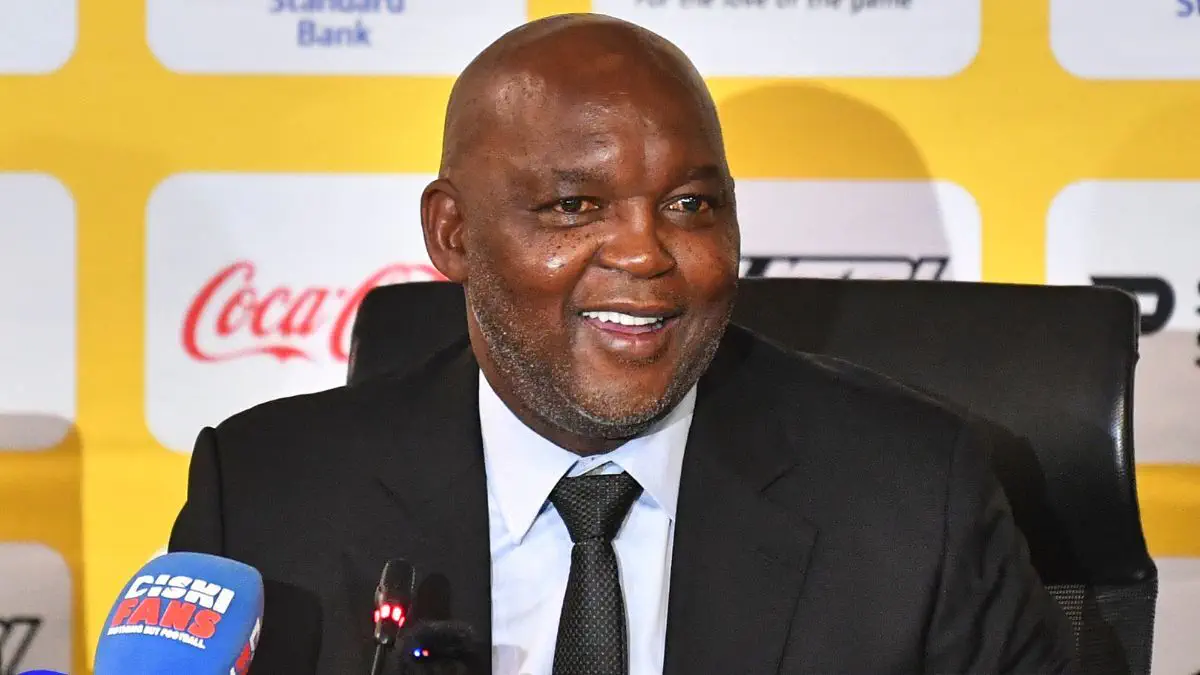
Pitso Mosimane has officially been appointed head coach of the South Africa national team. The 62-year-old succeeds Belgian Hugo Broos, who ended his five-year spell in charge. For Mosimane, this marks a return to Bafana Bafana after more than 14 years. He has already worked with the national team as both an assistant and caretaker manager, before taking permanent charge from 2010 to 2012. Now, however, a very different Mosimane is returning to South Africa — a coach with vast international experience and three CAF Champions League titles.
From Kagiso to the big time
Pitso John Hamilton Mosimane was born on 26 July 1964 in Kagiso, a township in the Krugersdorp area, west of Johannesburg. It was there that he grew up and first took up football. His journey was not the story of a boy coming through the academy of a European club: Mosimane followed the traditional South African football pathway and combined his sporting development with his education from an early age. He later repeatedly stressed how much his education helped him develop discipline, strategic thinking and leadership qualities.

Mosimane began his professional career at Jomo Cosmos, returning to the club several times during his playing days. He also represented Mamelodi Sundowns and Orlando Pirates — two teams of huge importance to the history of South African football. Towards the end of his playing career, Mosimane moved abroad, turning out for Greek side Ionikos, Belgian club KFC Rita Berlaar and Qatar's Al Sadd. His playing career saw him operate as a midfielder and gave him experience of several very different football cultures.

Mosimane made just four appearances for South Africa between 1993 and 1994, scoring one goal. In other words, he was not a major star at international level as a player — it was his subsequent coaching career that proved far more significant. However, his experience of playing for Bafana Bafana gave him an inside understanding of the national team and the pressure surrounding its players.
Interestingly, Mosimane moved into coaching relatively early. While living in Belgium, he gained experience working with young players, and in 2001 he took charge of SuperSport United. That was where he began his transformation into one of South Africa's most prominent coaches. At SuperSport, he won his first major trophies, including the Nedbank Cup and SAA Super Eight Cup, before being given the opportunity to work directly with the national team.

First spell with the national team and a glaring error against Sierra Leone
Before being appointed head coach on a permanent basis, Mosimane was already part of the Bafana Bafana set-up. In 2007, he served as caretaker manager and later worked as an assistant in Carlos Alberto Parreira's coaching staff at the 2010 World Cup on home soil. After the tournament, Mosimane was appointed permanent head coach of Bafana Bafana.
His first full spell in charge was a mixed one. Mosimane managed South Africa from 2010 to 2012 but failed to qualify the team for the 2012 Africa Cup of Nations. The clash with Sierra Leone in October 2011 holds a particularly significant place in the story of Mosimane's first spell in charge. That match effectively cost South Africa a place at the 2012 Africa Cup of Nations.
Bafana Bafana drew 0-0 with Sierra Leone at home and celebrated their qualification after the final whistle because the team and coaching staff had misunderstood the rules for determining the group winner. The coach admitted that he had changed his tactics and played for a draw, believing that would be enough to win the group and reach the finals of the continental tournament.
“Do you think I would have left [striker Lehlohonolo] Majoro on the bench and brought on a midfielder if I knew we needed a goal? It makes no sense. Africa is a jungle. The European and South American formats are much better because everything works like clockwork, but playing in Africa is very difficult,” Mosimane complained.
However, he was not the only one to have made a mistake by misinterpreting the rules.
- Read also: The hosts' title-challenging form meets a cautious newcomer: Mamelodi Sundowns vs Milford prediction
The South African Broadcasting Corporation announced that the team had qualified for the finals, while SAFA president Kirsten Nematandani even appeared on television to congratulate the team.
In reality, Niger held the advantage on head-to-head record in the event of teams being level on points, meaning South Africa needed a win. Bafana Bafana were ultimately left out of the tournament, and Mosimane was sacked soon afterwards. For a long time, this episode remained the main argument used by his critics: at international level, Mosimane had failed to deliver the results expected of him.
A phenomenal spell at Mamelodi Sundowns
After leaving the national team, however, his career took a dramatic upward turn. In December 2012, Mosimane took charge of Mamelodi Sundowns and spent almost eight years at the club. This period ultimately transformed him into a coach of genuine national stature. Under his leadership, Sundowns won the South African league title five times and, in 2016, claimed the CAF Champions League for the first time in the club's history. Mosimane became the first South African coach to win Africa's premier club competition.

And Sundowns' success was not a one-off. Mosimane built a team that remained one of the continent's leading clubs for years. His side were characterised by excellent organisation, possession control, discipline without the ball and the ability to adapt to their opponents. His capacity to work on a long-term project and gradually reshape a squad became one of the coach's defining qualities.
Al Ahly turned him into an African superstar
In 2020, Mosimane received an offer that was impossible to turn down: Egyptian giants Al Ahly came calling. It was a move to an entirely different level of pressure. In Cairo, the coach was expected to deliver more than just victories — the club were accustomed to fighting for every trophy, while defeat in an important match was treated as a crisis.
Mosimane delivered. In his first season, he won the CAF Champions League by beating Zamalek in the final. The following season, Al Ahly were crowned African champions again, this time after defeating Kaizer Chiefs. Mosimane therefore won the competition twice in a row with the Egyptian giants, adding those titles to his triumph with Sundowns. In total, he became a three-time CAF Champions League winner — a unique achievement for an African coach.
Even more importantly, Al Ahly under Mosimane consistently performed on the world stage. The team won bronze medals at the Club World Cup twice, while the coach led the Egyptian club to three consecutive CAF Champions League finals. This was no longer simply the story of a coach who knew how to win individual competitions: Mosimane proved he could keep a team at the highest level over several seasons.

After Al Ahly, the coach continued his international career. He worked with Al Ahli Saudi in Saudi Arabia, Al Wahda in the UAE, Abha and Iranian side Esteghlal. Mosimane therefore gained experience not only in South Africa and Egypt but also in the Middle East. This is an important factor behind his current appointment: he returns to the national team with a completely different wealth of knowledge and experience from the one he had when he left in 2012.
Why Mosimane?
At first glance, SAFA's decision looks logical. The organisation did not have to find a coach who would need to be introduced to the specifics of South African football. Mosimane knows the local players, the club system, the characteristics of the league and the pressure surrounding the national team. At the same time, he returns with experience from Al Ahly — one of Africa's biggest clubs, where the demands placed on a coach are comparable to those facing a national-team manager.
There is another important factor — Mosimane's ability to win at continental level. Three CAF Champions League titles speak for themselves. Over the course of his career, he has collected numerous domestic and international trophies.
- Read also: Can Osnabrück withstand the holders? Prediction for Osnabrück vs Bayern Munich - 02.09.2026
But there is also a serious question. Mosimane is not simply returning to the national team — he is taking over a side that enjoyed a notable rise under Hugo Broos. It was the Belgian who led South Africa to the 2026 World Cup, where Bafana Bafana reached the knockout stages for the first time in their history. Mosimane will therefore not be building the national team from scratch, but continuing the work with a squad that already has a certain structure and high expectations.
That is what makes the appointment particularly intriguing. Mosimane is a coach accustomed not merely to maintaining an existing level but to raising the bar. His best teams have been characterised by structure, intensity and confidence in big matches. If he can combine his experience with the foundation left by Broos, South Africa could genuinely become one of the contenders for a strong result at the Africa Cup of Nations.
This is not his first spell — it is a second chance
It is important to stress separately that Mosimane's current appointment is not his first stint with the South Africa national team. This is his second full spell in charge of Bafana Bafana. His first ended in 2012 following failure to qualify for the Africa Cup of Nations. Before that, he had already worked on the national team's coaching staff and served as caretaker manager.
That is why his return can be viewed as a second chance. Over the past 14 years, Mosimane has won three CAF Champions League titles, five South African league championships and the Egyptian league title. He has worked in different countries, experienced life at clubs under enormous pressure and gained the kind of experience he did not have when he was first appointed. At his presentation, Mosimane himself stressed that he was returning with far more experience and understood that working with a national team meant much more than an ordinary coaching job.
Where will the new era begin?
Mosimane has virtually no time to settle in. His first competitive match in his second full spell in charge of Bafana Bafana will come in September in the 2027 Africa Cup of Nations qualifiers. South Africa are due to host Guinea before travelling to Egypt for a neutral-site match against Eritrea. Kenya are also in the group, but as one of the tournament's host nations they have automatically qualified, meaning South Africa, Guinea and Eritrea will compete for the remaining place.
Symbolically, one of Mosimane's first major opponents will be Kenya, who are managed by another legendary South African footballer — Benni McCarthy. In November, Mosimane and McCarthy will face each other twice within four days. For South African football, this will be more than a clash between two national teams — it will be a fascinating duel between two generations of national football heroes in their new roles as coaches.
Mosimane is coming home as a coach who has already proved almost everything at club level. Now he must address the biggest unfinished business of his career — achieving major success with the South Africa national team. His first opportunity to do so will come very soon.
 Jan Novak
Dailysports's expert
Jan Novak
Dailysports's expert