
Future superstar or just hype? The truth about Cristiano Ronaldo Jr.
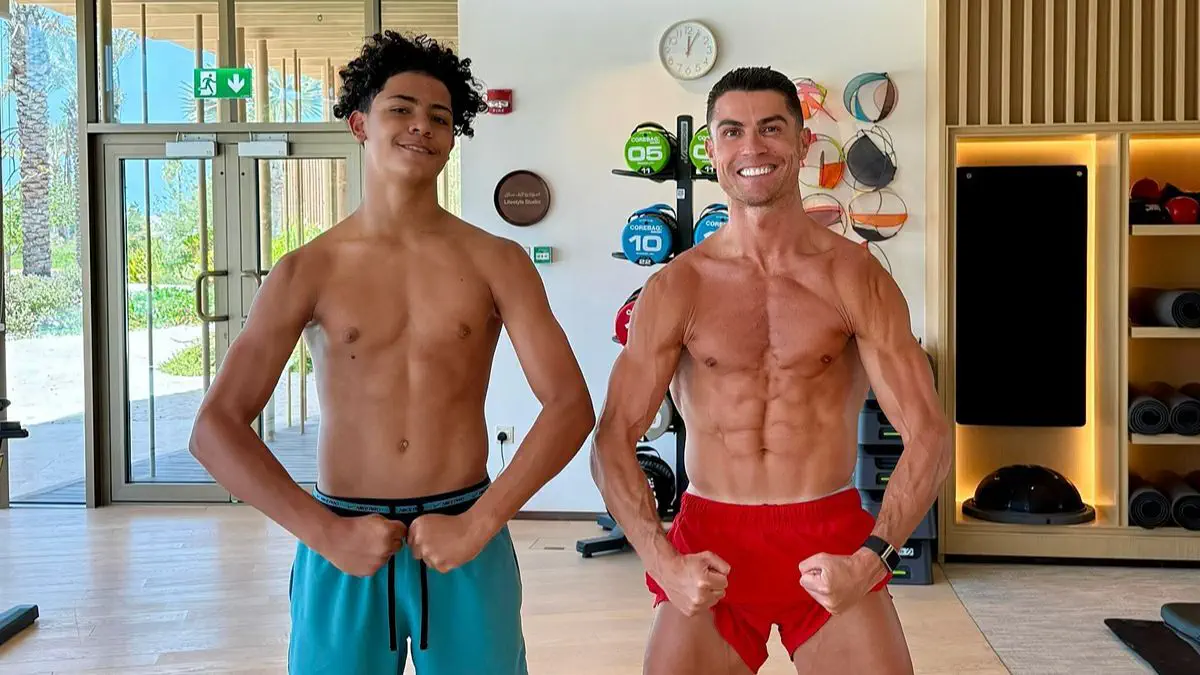
Cristiano Ronaldo’s 16-year-old son made his debut for Portugal’s U17 side just a week after his legendary father ended his international career. But instead of admiration, his first minutes on the pitch sparked a wave of mockery on social media. Are we really looking at a future star of world football, or does the famous name still run far ahead of the talent?
It took Cristiano Ronaldo more than two decades to become a football legend. It took his son around 17 minutes to come under a barrage of online criticism.
On November 12, 2026, 16-year-old Cristiano Ronaldo Jr. made his debut for Portugal’s U17 side in qualifying for the 2027 European Under-17 Championship. Portugal thrashed Andorra 4-0, with the legendary striker’s son coming off the bench in the 73rd minute wearing the No. 18 shirt.
The moment was symbolic. Just a week earlier, on November 5, the senior Ronaldo had announced his retirement from international football following a falling-out with Jorge Jesus.
It seemed like a script straight out of Hollywood: one Ronaldo leaves the Portugal team, while another begins his journey.
But the reality of football proved far less romantic.
While some saw Junior’s debut as the beginning of a new era, others viewed it as yet another reminder that a famous surname is no guarantee of footballing talent.
“Daddy’s privilege”: Ronaldo Jr. mercilessly mocked online
The criticism began before the young Portuguese player had even touched the ball for the U17s.
On November 2, coach Filipe Ramos named Cristiano Jr. in a provisional 23-man squad for matches against Andorra, Bulgaria and Serbia.
For many, this was a logical next step after his performances for Portugal’s younger age groups. But accusations of favoritism immediately surfaced on social media.
“Daddy’s privilege. I’ve seen him play many times, he shouldn’t be called up. He won’t add any value to the team,” wrote an X user with the handle @justvictor70.
One comment under a post by well-known transfer insider Fabrizio Romano was even harsher.
“I’ve seen this kid play. He’s San Marino level, not Portugal level. He’s taking the place of more talented players right now,” one fan claimed.
After his debut, the criticism only intensified.
Short clips of Ronaldo Jr.’s performance against Andorra began circulating widely on social media. Users particularly focused on his running style, coordination and unconvincing work on the ball.
Here’s what another user wrote:
“From the way he ran when he came on, I could tell how bad Cristiano Ronaldo Jr. is. He's going to stay in professional football thanks to his father, but he doesn't have a single thing that's even remotely extraordinary”.
Another fan sarcastically compared the 16-year-old striker to his 41-year-old father:
“You can really tell football isn't his thing—Ronaldo Jr. plays just like his father at 41 years old”.
Another post, featuring a clip of what its author considered the footballer’s awkward running style, came with a suggestion that he should consider college instead of a football career:
“Look at how Cristiano Ronaldo jr is running bro. It’s not too late for College buddy”.
Memes and more subtle trolling followed. One fan posted an image supposedly showing Cristiano Jr. scoring nine goals against Croatia U17:
All the social media reaction can be summed up in one question from fans: did we see anything that suggests he could become a world-class footballer?
So far, the answer is not particularly encouraging.
What did Ronaldo Jr. actually show in his debut?
By the time Junior came on against Andorra, Portugal were already 4-0 up. The result was all but settled, and the striker wasn’t required to rescue his team or perform under serious tournament pressure.
Even so, his appearance was hardly dazzling.
The young forward struggled to get on the ball regularly and link up with Portugal’s attacks. He did not produce a series of dangerous runs, dazzling dribbles or individual moments that would make people sit up and take notice of a special talent.
Compared with some of his teammates, he was largely anonymous.
For example, Sporting CP winger Diogo Farinha was one of the stars of the match, scoring twice. Kauã Miranda and Rafael Cabral also got on the scoresheet.
Ronaldo Jr., by contrast, spent almost all of his time on the pitch in the background.
In the 88th minute, the striker wasted a golden opportunity: he met a cross from the left and sent a header narrowly wide while under pressure from two defenders.
It was his best moment of the match and a genuine chance to score on his debut.
The reaction from the Spanish press was also telling.
AS noted that Ronaldo Jr.’s game currently shows little resemblance to that of his famous father. The journalists described his debut as quiet and uneventful, while acknowledging his potential to develop and pointing to his dangerous header.
Even this relatively measured assessment falls a long way short of the breathless headlines proclaiming the arrival of a new superstar.
Then, on November 14, when Portugal drew 1-1 with Bulgaria, Junior spent the entire match on the bench. Coach Filipe Ramos made three changes in attack but still did not bring Ronaldo’s son on.
That is no verdict on his ability, but it is another reminder that he is not a regular in his national team at this stage.
Did Real Madrid turn him down? What Ronaldo Jr.’s trial in Madrid revealed
Perhaps the most telling story about Junior’s current level came before his Portugal U17 debut.
In March 2026, Cristiano Jr. had the chance to train with Real Madrid’s youth team.
It was the club where his father spent nine legendary years, won four Champions League titles and became Los Blancos’ all-time leading goalscorer.
At the time, the 15-year-old Junior trained with Cadete A, Real Madrid’s U16 team.
The Portuguese teenager was in Madrid with his family while his father recovered from an injury. The club allowed the son of its legend to join academy training sessions.
According to one ESPN source, the scouting reports Real Madrid had on Ronaldo Jr. were not positive. Talk of the player joining the club’s academy came to an end.
Of course, one scouting report does not determine the future of a 15-year-old footballer. The game is full of players who were overlooked at a young age.
But so far, Ronaldo Jr.’s most high-profile story at Real Madrid has not been about his achievements on the pitch, but about getting the chance to train at his father’s former club.
That says a lot about where his career stands right now.
It’s not all bad: Junior has real achievements to his name
Still, it would be unfair to call Cristiano Jr. a footballer with no talent whatsoever.
He has come through the academies of Juventus and Manchester United, and now plays for Saudi side Al-Nassr’s youth team.
Junior has also enjoyed some success with Portugal’s youth national teams.
Before making his U17 debut, he had made 13 appearances for the U15 and U16 sides, scoring 5 goals.
May 2025 was a particularly memorable month. In the final of the Vlatko Marković International Tournament against Croatia U15, Ronaldo’s son scored twice to help Portugal win 3-2.
He scored one with a powerful strike and the other with a header. After finding the net, Junior also recreated his father’s famous “Siuuu” celebration.
He caught the eye again in September 2026, scoring both goals in Al-Nassr U17’s 2-1 win over Al-Ahli and being named player of the match.
Taller than his father, but nothing like him
There is another interesting detail: according to Transfermarkt, 16-year-old Junior is already 190 centimetres tall—taller than his father.
That matters when it comes to understanding his style of play.
As a young player, Cristiano Sr. was an explosive winger who could beat several opponents with his pace, dribbling and outstanding coordination.
His son has a very different build. He looks more like a tall centre-forward who could make use of his height, physicality in the box and aerial ability.
So it is not entirely fair to expect him to make the same movements that a young Cristiano did at Manchester United.
Besides, at 16, he is still growing, and a tall teenager’s coordination can change as his body develops.
But there is another side to the story: so far, Junior has not shown the kind of exceptional qualities that would put him among the most talented players of his generation.
Was Cristiano Jr. called up because of who his father is?
That is probably the most controversial question in the whole story.
In early October 2026, Portuguese media reported that the senior Ronaldo was unhappy that his son had not been included in the U16 and U17 squads.
Record deputy editor Vítor Pinto said on CMTV that the coaching staff’s decision had upset the five-time Ballon d’Or winner.
About a month later, on November 2, Cristiano Jr. was named in a new Portugal squad. It was a coincidence that, naturally, did not go unnoticed—particularly amid the federation’s failed attempt to persuade the senior Ronaldo to return to the national team.
Junior had already played for the U15 and U16 teams, so moving up to the next age group was not entirely unexpected.
Still, it is obvious that being Cristiano Ronaldo’s son brings opportunities most young footballers can only dream of.
Top-class training facilities, access to world-class professionals, advice from one of the greatest players in history and constant attention from the football industry. That is a huge head start.
But there is one thing even Cristiano Ronaldo cannot give his son: world-class talent.
And no connections will be able to hide its absence if Junior one day comes up against Europe’s best defenders.
A father’s dream and pressure not everyone could handle
Cristiano has spoken more than once about his wish to play alongside his son at the professional level one day.
But time to make that dream come true is running out fast.
In August 2026, the 41-year-old Portuguese told Vogue that the current season would probably be the last of his career.
That means Junior may have very little time left to make his first-team debut for Al-Nassr and share the pitch with his father.
But Cristiano Jr.’s biggest challenge is not even his footballing ability. It is his surname.
In a November 2025 interview with CNN, the senior Ronaldo admitted that he does not want his son to feel pressured by his achievements.
“I want him to be happy. It doesn’t matter whether he wants to play football or do another sport. He shouldn’t feel pressure because of his father, because that pressure is enormous,” Cristiano explained.
And there is a certain paradox in that.
The father wants to protect Junior from pressure, but his name turns every one of his son’s matches into a global news event.
Every goal becomes an excuse for a highlight reel about the birth of a new genius. Every mistake is treated as proof that he supposedly does not deserve to play football.
If an unknown 16-year-old Al-Nassr academy striker had made the same debut against Andorra, no one would be discussing his running style beyond a small circle of football fans.
But the Ronaldo name turns even an ordinary substitute appearance into a global news event.
So, will Ronaldo Jr. become a major star?
As of November 2026, there is little reason to be especially optimistic about Junior’s future as a superstar.
Yes, he is already playing for Portugal’s youth teams, scoring for Al-Nassr’s academy and progressing through the stages of his football development. Those are real achievements and should not be dismissed.
But his current popularity is completely out of proportion to what he has achieved on the pitch so far.
Unfavourable early scouting reports, an unconvincing U17 debut and his lack of a regular place in the national team mean that, for now, it is too soon to call him a future world-class footballer.
At 16, Junior is far more famous in the media than most talented academy graduates in Europe. But that popularity is almost entirely tied to his father, not his own exploits on the pitch.
On the other hand, it is too early to write him off completely. He is only 16, with several years of development ahead of him, and not every great footballer looked like a future Ballon d’Or winner at that age.
The real test is still to come.
Football history is full of children of legendary players who never matched their fathers’ success. But there are also success stories, including Erling Haaland, Marcus Thuram and Daniel Maldini, who have built careers of their own.
Perhaps Cristiano Jr. will find his own path too.
Or perhaps he will always be known first and foremost as Cristiano Ronaldo’s son, rather than as a footballer remembered for his own achievements.
For now, Ronaldo Jr. is a promising young player with a legendary surname, whose fame far outweighs his achievements on the pitch.
 Steven Perez
Dailysports's expert